
Do You Need a Defibrillator? What the New First Aid Standard Really Says
If you work in construction, you'll already know that falls from height are the industry's oldest and most stubborn problem. What might surprise you is just how
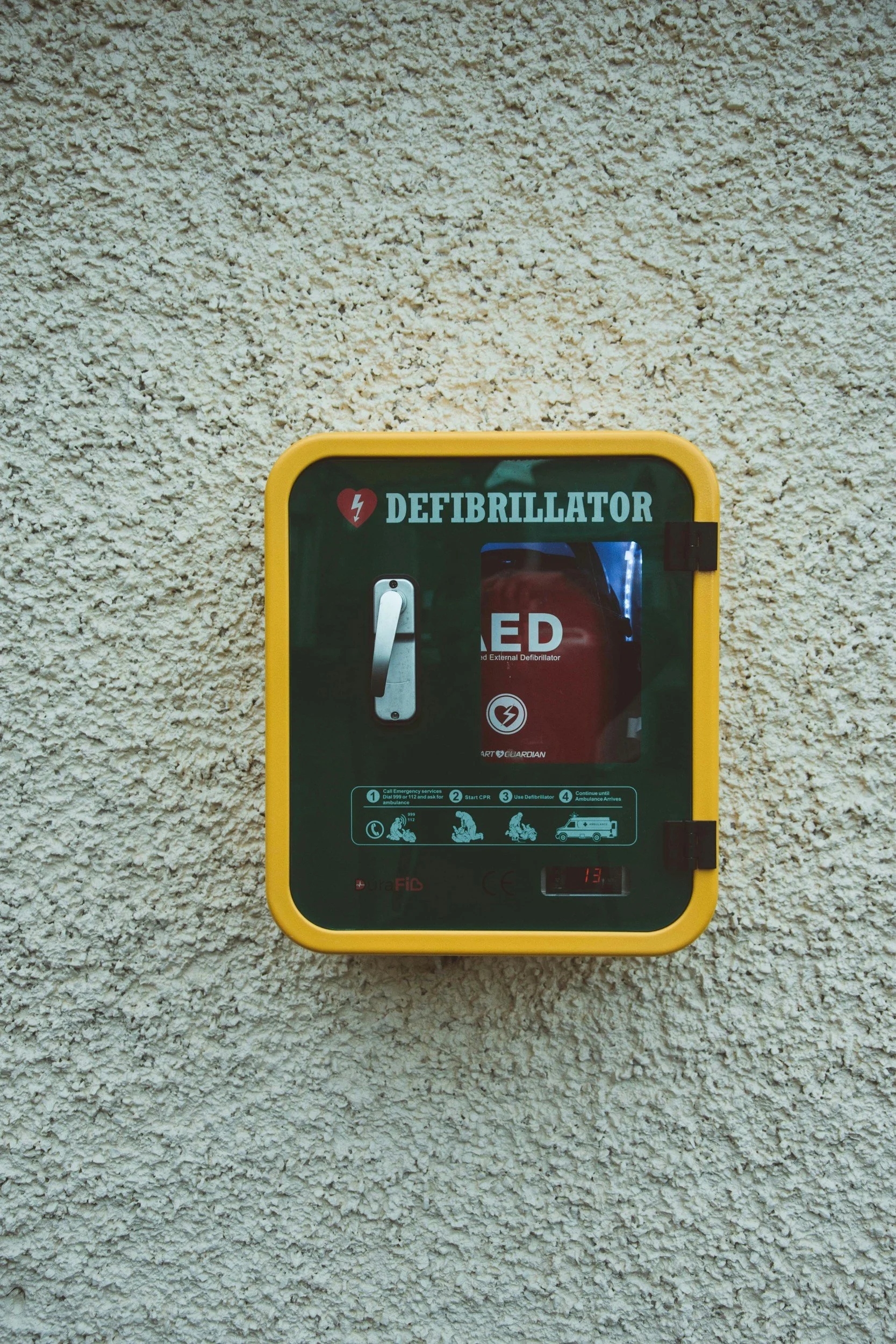
If you've heard that “workplaces with five or more people now need a defibrillator,” you've heard right up to a point. On 30 April 2026, the British Standards Institution released an amendment to the standard for workplace first aid kits, BS 8599-1:2019+A1:2026, and one of its headline changes is exactly that: an expectation that sites with five or more people present, including staff, visitors and customers, should provide an Automated External Defibrillator (AED).
It's a significant shift, but it's important to be clear about what it actually is and isn't.
What the standard says
The amendment sets out what's become known as the “two-minute AED rule”: any site with five or more people present should have a defibrillator that can be retrieved and made ready to use within two minutes of a cardiac arrest. In practice, that means roughly one minute to locate the device and another to prepare and deliver treatment. For larger sites, or those spread across multiple buildings or floors, that often means more than one AED is needed to keep every part of the workplace within reach.
The amendment doesn't stop at defibrillators. It also pushes workplaces towards a more risk-based approach generally, with a sharper focus on burns kits where burn risks exist, eyewash provision where there's an eye injury risk, and clearer expectations around lone workers, home workers and vehicle first aid kits.
Is it actually the law?
No and this is the point worth holding onto. There is no primary UK statute requiring general businesses to provide a defibrillator (state-funded schools are the one exception, following a Department for Education commitment). BS 8599-1 is a British Standard, not legislation, and the Health and Safety (First-Aid) Regulations 1981 remain the underlying legal duty: employers must provide “adequate and appropriate” equipment, facilities and personnel so employees can be given immediate attention if they're injured or taken ill at work. That duty applies to every workplace, including those with fewer than five staff.
What the new standard does is reset what “adequate and appropriate” is now understood to mean. Following a recognised British Standard gives an employer a strong, demonstrable defence if provision is ever questioned by an inspector, an insurer, or a court. Choosing not to follow it isn't illegal, but it does shift the burden onto the employer to show that whatever alternative arrangement is in place is genuinely just as effective a harder conversation to have after the fact.
What this means in practice
For construction sites, workshops, manufacturing units and anywhere else with a shifting or dispersed workforce, this is worth taking seriously rather than filing away:
• Revisit your first aid needs assessment. If your total headcount, including visitors and contractors on site, regularly reaches five or more, the AED expectation applies — and if it's five or more employees specifically, your first aid risk assessment needs to be recorded in writing.
• Think about retrieval time, not just ownership. A defibrillator locked in a site office half the yard away doesn't meet the two-minute standard. Location matters as much as provision.
• Don't forget mobile and remote workers. Site-based teams working across multiple locations, lone workers, and staff using company vehicles all fall within the scope of the wider review, not just the main office or depot.
• A nearby public AED isn't automatically enough. It's a good community resource, but it rarely satisfies an employer's own first aid duty on its own.
• Pair equipment with training. An AED is only useful if someone on site is confident using it this is a good moment to build a short Basic Life Support refresher into your training plan.
The bottom line
Nobody is required to rush out and buy a defibrillator tomorrow. But the direction of travel is clear, and “we didn't think about it” is a weaker position than it used to be. If you haven't looked at your first aid needs assessment since before April 2026, now's a sensible time to check it against the new standard before an incident, an inspection, or an insurer does it for you.